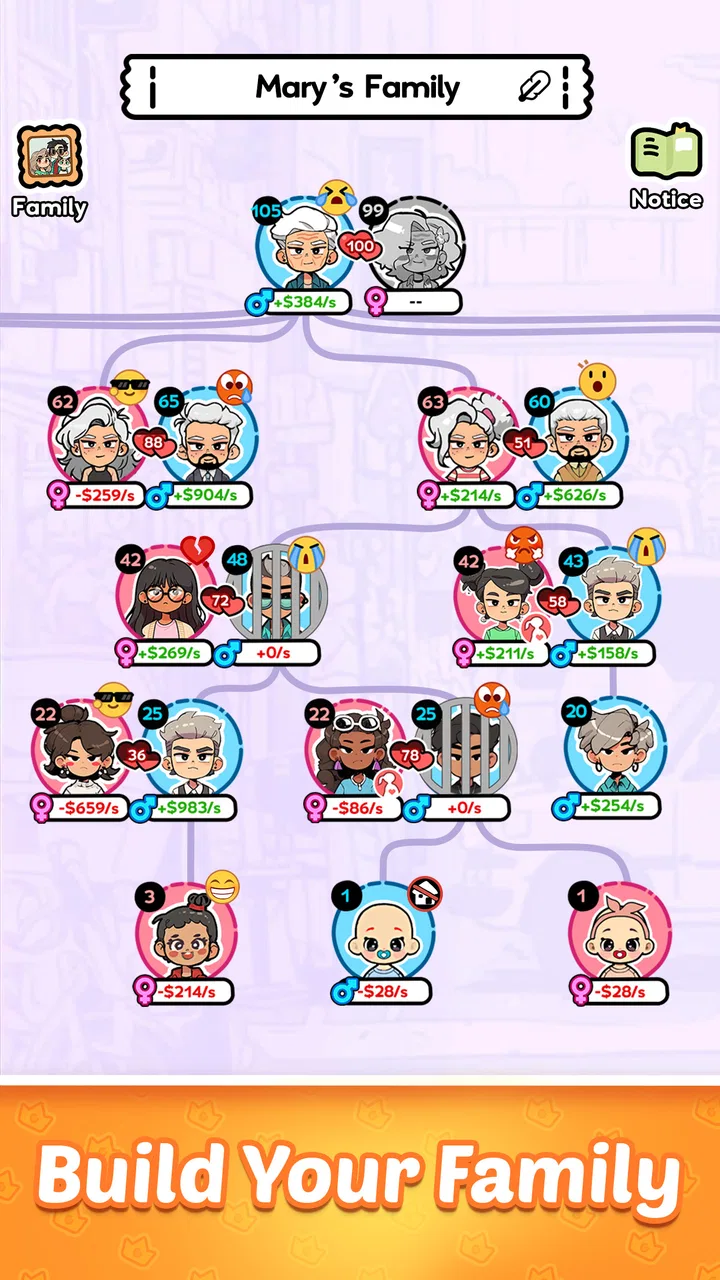
Family Go! - Lifetime Sim game
- 3.9
- Rating
- 1.00M
- Installs
- Free
- Price

 Analysis by App-foxy
Family Go! - Lifetime Sim caught my attention because it combines two familiar casual-game ideas: making choices across a family story and improving a small town over time. I usually approach this kind of game expecting a relaxed experience rather than a deep simulation, and that is the right mindset here. The appeal is in watching decisions shape a longer-running legacy while gradually giving the setting more structure.
After spending time with it, I found the game most enjoyable when I treated it as a short, repeatable check-in rather than a demanding strategy project. Its presentation aims for a warm, accessible mood, while the life-choice format gives each session a personal angle. It is not trying to replace a complex management game or a detailed life simulator. Instead, it offers a lighter route into those ideas for players who enjoy progress, family themes, and town development without wanting a steep learning curve.
Family Go! is a free casual game from KIKO FUN INTERACTIVE ENTERTAINMENT CO., LIMITED. It has an average rating of 3.9 from around 1.5 thousand ratings, with more than 100 thousand installs. That makes it a reasonably visible choice in its niche, although the rating also suggests that the experience will suit some players much more than others. The game is rated Teen, and it runs on Android 6.0 or later. Version 1.4.3.0 is the version I would look for when checking compatibility before installing.
You May Also Like

 Blood Strike: 2.5 Anniversary
Blood Strike’s Loadouts Turn Every Drop Into a Tactical Gamble
A close look at Blood Strike’s custom loadouts: how fast access to signature weapons reshapes its battle royale rhythm, rewards preparation, and narrows the gap between fights.

 Pandora - Music & Podcasts
Pandora’s Music Is Easy to Start, but Harder to Recover
Pandora’s strength is its low-effort path from a seed to a station. Its weak spot is how much confidence it asks you to place in connection, setup, and quiet recovery.

 8 Ball Pool
 Is Built on Rivalries, Rematches, and Routine
A close look at the rivalries, rematches, shared routines, and unanswered safety questions that turn a quick pool match into a persistent mobile community.

 Samsung Music
’s Quiet Strength Is Playing What You Already Own
Its reach comes less from spectacle than from dependable access to a personal library. That simplicity is both the app’s strongest retention engine and its ceiling.

 AccuWeather: Weather Radar
AccuWeather Review: A Quick, Clear Forecast for Everyday Decisions
For everyday plans, the best forecast is the one you can understand quickly. AccuWeather makes rain timing, radar, and local conditions easy to act on, with a few trade-offs.

 Hill Climb Racing
Why Hill Climb Racing Still Turns Crashes Into One More Run
A tiny car, a bumpy hill and one more upgrade: Hill Climb Racing keeps resurfacing because its simple chaos makes every near-miss feel personal.
More From Our News Desk
View All News


How the first minutes establish the game’s mood
The first impression is shaped less by technical complexity and more by the promise of a continuing personal story. The combination of family decisions and town-building gives the game a clear emotional direction: I am not simply collecting items or clearing isolated stages; I am building something that is meant to feel connected across time.
That framing matters because casual games can otherwise feel interchangeable. Here, the family angle gives ordinary progress a little more meaning. A choice can be read as part of a character’s path, while a town improvement suggests that the consequences extend beyond one individual. Even when the underlying activity is simple, the setting encourages me to think in terms of continuity rather than a single score.
The presentation is approachable, which helps the game work as a low-pressure introduction to life-simulation ideas. I did not feel pushed to understand a large collection of systems immediately. Instead, the experience invites me to learn by following the flow of choices and observing how the broader legacy develops. That is useful for players who enjoy discovery but dislike being confronted with a dense tutorial or a large management screen at the beginning.
There is also a trade-off in this gentle opening. Players who want immediate strategic tension may find the early rhythm too mild. The game’s central appeal depends on caring about gradual development, so it is less compelling if I only want quick competition, precise optimization, or dramatic action. Its first impression works best when I am willing to let the story-like structure carry some of the excitement.
A good fit for short, repeatable play
In everyday use, I can imagine opening the game during a short break, making a few decisions, checking the state of the town, and leaving without feeling that I have abandoned a complicated campaign. That makes it more convenient than many traditional simulation games, which often demand longer sessions to make progress feel worthwhile.
A realistic example would be a player who has a few minutes before commuting or between household tasks. Family Go! can provide a small sense of continuity: I return to the family thread, make the next meaningful choice, and see whether the town feels more developed afterward. The experience is particularly suitable for people who like the satisfaction of gradual change but do not want to spend an entire evening managing resources.
On the other hand, this same structure may feel repetitive to someone who expects every session to introduce a completely new challenge. The game’s attraction comes from accumulation and atmosphere. If I am not interested in following a legacy or watching a setting grow, the individual actions may not provide enough variety on their own.
The visual language of family, place, and progress
The art direction has an important job because the game needs to connect personal decisions with town development. A purely functional interface would make those two parts feel like separate menus. The warmer life-simulation framing gives them a shared identity, helping the family story and the town feel like parts of one journey rather than unrelated activities placed beside each other.
I found that the setting works best when I read it as a backdrop for continuity. The town is not merely a collection of upgrades; it represents the visible result of choices made over time. Likewise, the family is not only a list of characters or events. Together, these elements create a visual language of belonging, inheritance, and gradual change.
This is one of the game’s more useful design decisions. In a standard casual builder, a new improvement can feel like another reward on a progress track. In this context, the same kind of progress can feel more personal because it is attached to a family legacy. That does not make every decision profound, but it gives the routine a stronger reason to continue.
My advice is to pay attention to the relationship between the choice screens and the town view instead of treating them as separate tasks. The practical benefit is that it becomes easier to judge whether the game’s pacing suits you. If the visual promise of a growing community appeals to you, the slower progression can feel satisfying. If you prefer direct, constantly visible rewards, you may find the connection too indirect.
Where the setting helps and where it cannot carry the game
The family-and-town setting gives Family Go! a clearer identity than a generic casual progression loop. It also makes the game easier to recommend to players who enjoy stories about generations, domestic decisions, and building a shared place. Someone looking for a softer alternative to competitive games may appreciate that the mood is centered on development rather than confrontation.
Still, visual coherence cannot solve every mechanical limitation. A pleasant setting can make repeated actions more comfortable, but it cannot make a shallow decision feel deep forever. I would therefore judge the game on two levels: whether I like its atmosphere, and whether the choices offer enough variation for my own tolerance for repetition. The first answer may be yes while the second remains uncertain.
This is also why the Teen content rating is worth noticing before installation. The rating sets an expectation that the family-life framing is not necessarily aimed at very young children. Parents choosing a game for a child should consider that rating rather than assuming that a colorful casual presentation automatically means it is suitable for everyone.
Sound, pacing, and the feeling of a living routine
Sound and rhythm are especially important in a game built around everyday decisions. The experience needs to feel inviting enough for repeated visits, but it should not become so busy that the family theme loses its calm character. In my view, the strongest mood comes from the contrast between small, manageable actions and the larger idea of a lifetime unfolding through them.
The pacing encourages me to think in intervals. I make progress, pause, and return later with the expectation that the next decision will continue the same thread. That rhythm is different from an action game, where momentum comes from constant movement, and from a puzzle game, where the main reward is solving a single contained problem. Here, the reward is the sense of an ongoing household and community.
That makes the game a good companion for relaxed play. I would not choose it when I need intense stimulation or a strong competitive push. I would choose it when I want something that can occupy a few minutes without demanding complete concentration. The mood is more successful when I allow the game to remain gentle instead of trying to force it into a faster, more dramatic format.
The pacing also affects how I evaluate decisions. In a fast game, a weak choice can be replaced quickly. In a lifetime-style simulation, I am more likely to pause and consider the direction I want the family or town to take. Even if the consequences are presented simply, the slower rhythm encourages a more reflective style of play.
How to avoid turning the rhythm into a chore
My most practical suggestion is to play in deliberate sessions rather than checking constantly out of habit. Because the game is built around gradual progress, repeatedly opening it without a clear goal can make the routine feel like housekeeping. A better approach is to decide what I want from a visit: continue the family path, inspect town development, or simply make the next available choice.
I also recommend resisting the urge to measure the game only by how quickly the town expands. The atmosphere depends on the journey, and rushing through the visible progress can make the life-simulation framing feel less meaningful. Players who enjoy collecting every reward as efficiently as possible may prefer a more traditional builder, where optimization is the central pleasure.
Free access makes it easy to try this rhythm without an upfront purchase. However, in-app purchases range from $0.99 to $99.99 per item, so I would approach optional spending carefully. The broad price range means it is sensible to decide in advance whether I am treating the game as a completely free pastime or allowing purchases as part of the experience. That simple boundary can prevent a relaxed game from becoming an impulsive expense.
How the mechanics support the life-simulation idea
The main mechanical fit comes from connecting choices with construction. A family legacy gives the game a reason to continue, while town-building supplies a visible sense of progress. These two layers support each other: decisions provide the personal side, and development provides the tangible side. Without the family element, the building could feel ordinary; without the town, the life choices might feel disconnected from the wider world.
I like this combination because it gives different kinds of players an entry point. Someone who prefers narrative choices can focus on the family direction. Someone who enjoys incremental building can pay closer attention to the town. The game does not need either interest to be extremely complex for the combination to work as a casual experience.
One non-obvious strength is that the setting can change how I interpret efficiency. In a conventional builder, the best move is usually the one that produces the fastest material or numerical advantage. Here, I can also think about whether a choice feels consistent with the kind of legacy I want to create. That personal filter adds replay value even when the mechanical rewards are straightforward.
There is a corresponding limitation: players who want transparent, highly detailed systems may find the simulation too light. If I need extensive control over every character, a large economic model, or a precise competitive meta, this is probably not the right choice. The game’s strength is accessibility and mood, not exhaustive simulation.
Who will enjoy it most
I would recommend Family Go! to players who like casual games with a continuing sense of identity. It is a good match for someone who enjoys making choices, watching a community develop, and returning to a familiar setting over multiple short sessions. It may also suit players who find standard match-based casual games too disposable and want their progress to feel more connected.
It is less suitable for people who want immediate action, demanding puzzles, or a clearly defined win condition. It is also not my first recommendation for a player seeking a serious life simulator with detailed control. A deeper simulation game would be better for someone who wants to manage complex relationships, schedules, economies, or long-term consequences with precision.
Compared with the usual alternatives in the casual category, this game’s advantage is its blend of family narrative and town development. A pure city builder generally emphasizes expansion and resource planning. A choice-driven life game generally emphasizes events and personal outcomes. Family Go! sits between those approaches, offering a softer version of both. The trade-off is that it may not satisfy specialists in either side.
For a household sharing one device, I would also keep expectations realistic. The family theme can make the game feel broadly approachable, but the Teen rating means I would not hand it to a young child without checking whether its content fits the family’s standards. For an adult or older teen who wants a calm, story-tinged builder, the premise is easier to recommend.
Practical decisions before installing
The game is free to install, which lowers the risk of trying it. I would first check that the device uses Android 6.0 or later, then decide whether I am comfortable with the optional purchase range before beginning. That is especially important for anyone who shares a device with children or prefers games with no spending temptation.
The current version is 1.4.3.0, so I would use that version as the reference point when troubleshooting basic compatibility or comparing my experience with another player’s. I would also remember that a rating of 3.9 is an invitation to try rather than a guarantee of universal appeal. The game has found an audience, but its slower, choice-led structure will naturally divide players.
One useful way to test it is to give the opening progression enough time to show how the family and town systems relate. If I judge it after only a few taps, I may miss the point of the legacy structure. If the relationship between personal decisions and visible development still does not interest me after that initial period, a more focused city builder or a more story-heavy life game will probably be a better fit.
Atmosphere verdict: a gentle legacy game with clear limits
Family Go! succeeds most clearly as a mood-driven casual experience. Its art direction, family setting, and measured rhythm work together to create a playable sense of continuity. I enjoy it more when I treat the town as a reflection of a longer family journey, not simply as a board filled with upgrades.
The game’s strongest insight is that ordinary progress feels more memorable when it belongs to a place and a family. That connection gives short sessions a little emotional context and separates the experience from a standard builder loop. It also creates a useful middle ground for players who want more personality than a basic casual game but less complexity than a full simulation.
Its weaknesses are just as important. The relaxed pace will not satisfy everyone, and the mechanics may feel too light for players who want detailed control or constant challenge. The in-app purchase range also deserves a deliberate approach, even though the game itself is free. Finally, the Teen rating means the family-friendly appearance should not be the only factor in deciding whether it is suitable for a younger player.
My final recommendation is selective but positive. I would suggest trying it if you like casual town-building, life choices, and progress that unfolds over time. I would skip it in favor of a deeper simulator if I wanted complex systems, or a faster casual game if I wanted immediate rewards. For the right player, the best reason to play is the coherent mood created by family decisions and a growing town. That atmosphere gives Family Go! its personality, even when its lighter mechanics show through.
FAQs for Family Go! - Lifetime Sim game
01What is the main objective of Family Go! - Lifetime Sim?
Family Go! - Lifetime Sim is designed to let players create and manage a virtual family through various stages of life. The main objective is to guide your family members through real-life scenarios, make important decisions, and watch how these choices impact their lives. It's about simulating life experiences and enjoying the journey.
02Are there in-app purchases in Family Go! - Lifetime Sim?
Yes, Family Go! - Lifetime Sim offers in-app purchases. While the game is free to download, players can buy virtual currency and items to enhance their gaming experience. These purchases can help unlock special features, speed up progress, or customize characters, but they are completely optional.
03Is an internet connection required to play Family Go! - Lifetime Sim?
An internet connection is required for certain features of Family Go! - Lifetime Sim, such as accessing online leaderboards and updates. However, the game can be played offline for most of the fundamental gameplay. Keep in mind that some content might only be available when connected to the internet.
04What age group is Family Go! - Lifetime Sim suitable for?
Family Go! - Lifetime Sim is designed for players aged 12 and above. The game includes themes of life management, decision-making, and family simulation, which are suitable for teenagers and adults. Parents may want to review the game content to ensure it aligns with their expectations for younger players.
05Can I play Family Go! - Lifetime Sim on multiple devices?
Yes, Family Go! - Lifetime Sim supports cross-device play through account synchronization. By linking your game progress to an account, you can seamlessly continue playing on different devices, whether Android or iOS. This feature ensures your progress and purchases are saved and accessible anywhere.
Pros
- Engaging storyline with diverse outcomes.
- Unique character customization options.
- Realistic life simulation elements.
- Multiple career paths and achievements.
- User-friendly interface with smooth navigation.
Cons
- In-app purchases can be costly.
- Occasional ads interrupt gameplay.
- Limited offline functionality.
- Some features require premium subscription.
- Initial load times can be lengthy.

Family Go! - Lifetime Sim game
Gallery